Among the ancient Egyptians, honey was far more than a sweetener, it was one of the most valued medicinal ingredients. In fact, it appears in over 900 remedies in the Ebers Papyrus, where it was used as a natural antibiotic, for wound healing, and as a base for ointments. Its anti-inflammatory and antibacterial properties were well recognized long before modern science confirmed them.
Honey also held a sacred place in daily life and spiritual practices. It was offered on temple altars, used in embalming, and included in healing preparations and perfumes, most notably in Kyphi, one of the most famous ancient Egyptian aromatic blends. Because of its value, honey was often reserved for the wealthy and was known as “liquid gold.”
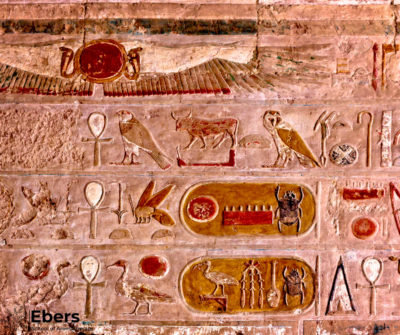
During one of my visits to Egypt, I found myself studying temple engravings, looking for visual stories I could bring into my teaching. At Karnak Temple, surrounded by intricate carvings, one image stood out, a simple depiction of a bee. At the time, I didn’t think much of it.
But recently, after teaching The Art of Egyptian Perfume workshop—where we worked with beeswax absolute, that image came back to me. Beeswax absolute, extracted from honeycomb, carries a rich, balsamic, honey-like scent with a slightly animalic depth. It’s a material that connects you instantly to both nature and history.
That curiosity led me deeper. I began researching honey in ancient civilizations and came across the book The Tears of Re by Gene Kritsky. One passage stayed with me:
“The god Re wept, and the tears from his eyes fell on the ground and turned into a bee… and so wax was made and honey out of the tears of Re.”
It was a beautiful reminder of how deeply sacred bees and honey were in ancient Egyptian culture.
Beekeeping itself was a sophisticated practice. Bees were tended by temple keepers, and hives were often placed near temples. Beekeepers used gentle smoke from burning incense to calm the bees before harvesting. Honey was stored in horizontal clay cylinders made from Nile clay, stacked together like walls. To harvest, the keeper would remove a wooden seal and carefully extract the honeycomb—a method still used in parts of southern Egypt today.
Even today, Egypt remains an important player in the global honey industry, producing and exporting honey and bees across Africa and the Middle East. Egyptian honey varieties include:
• Alfalfa Honey
• Black Seed Honey
• Citrus Honey
• Clover Honey
• Cotton Honey
• Mountain Flower Honey
What started as a simple curiosity became a deeper appreciation of how honey connects healing, culture, spirituality, and sustainability across time.